Rebecca Lefebvre
[heart wide open]
From the Beginning
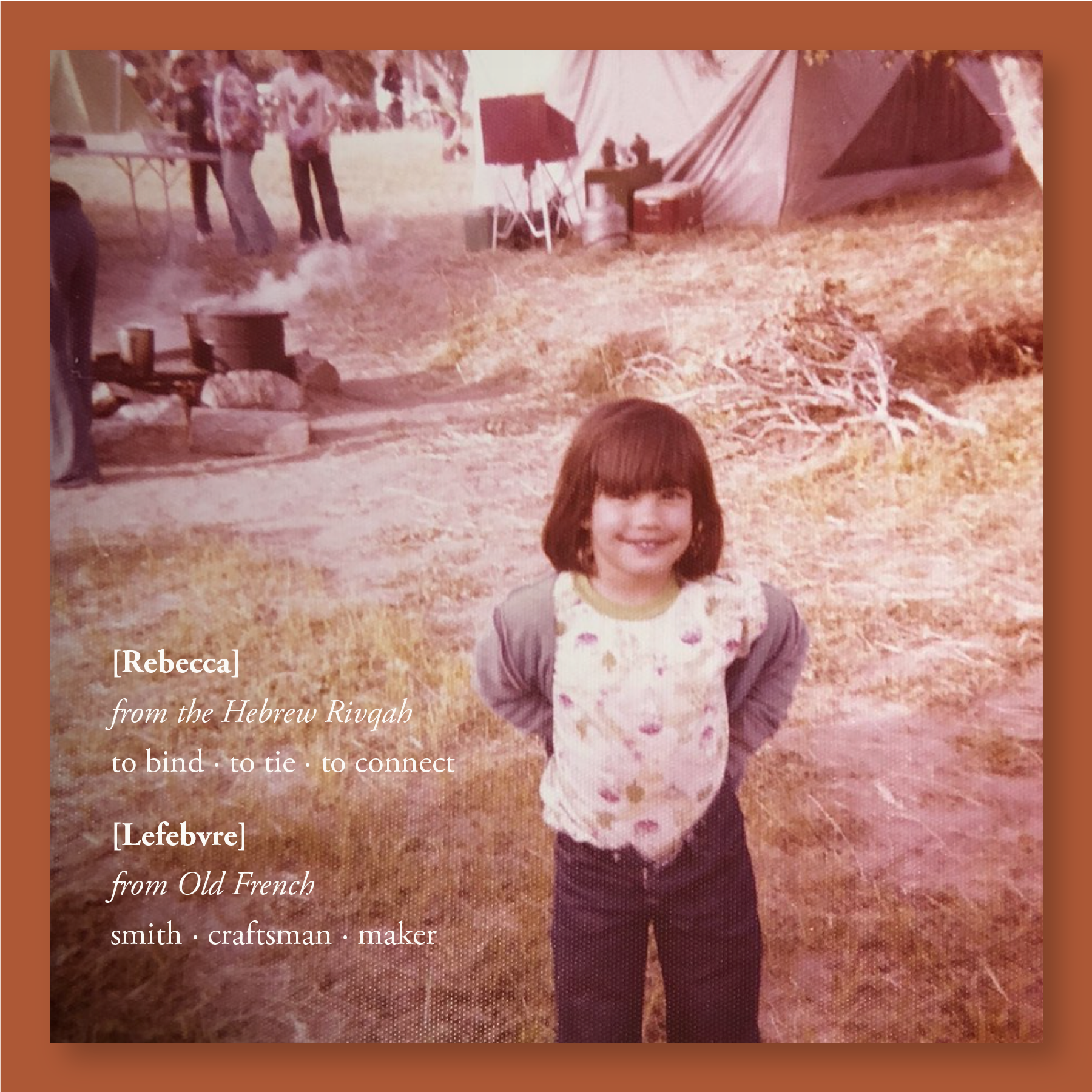
As far back as I can remember—maybe as early as four or five—I’ve been hyper-curious about our species. One of my first memories is sitting on the edge of a pink bathtub watching my great-grandmother get ready for church. She spoke only French. I spoke English (as best a five-year-old could). I can still remember the perfume she dotted behind her ear, the curling rods on the floor, and her matching cherry-red robe and slippers. We didn’t speak the same language, but somehow we understood each other. A hand gesture. A wink and a nod. A smile from ear to ear.
At that time, those seemingly incidental exchanges created a closeness I was too young to fully understand—but would crystalize a few decades later. Donning a nursing pin and stethoscope, I found myself sitting on the edge again—this time beside young families swaddling their newborn baby and later, older adults grappling with end-of-life decisions without any perfect solution.
Now in my fifth decade, I can say with some confidence that very little about being human goes to plan. Mostly, we’re making it up as we go. One moment pushes us into the next. One relationship changes the course of another. Sometimes we move through each other’s lives like bumper cars at an amusement park—colliding, redirecting, surprising one another. And sometimes, we move more like starlings—listening and holding on to those closest to us to make sense of this life.
Why Nature
Over the years, I’ve come to think of nature as our greatest unifier—though it gets very little cred and not enough respect. No matter someone’s beliefs, religion, upbringing, culture, or socioeconomic status, we seem to instinctively reach for nature when we need to feel like ourselves again. It’s almost second nature (yes, the irony is intentional).
Working with patients who have been hospitalized for long periods of time, I sometimes ask, “What’s the first thing you’re going to do when you get out of here?” Again and again, their answers are simple and straightforward: go for a walk, sit under a tree, feel the sun on my face or take my kids to the park. A little space to feel human again.
I also started to notice how naturally we identify with the living world. We see ourselves in birds and foxes, trees and flowers, seeds and storms, and even in the fantastical creatures we invent. Sometimes it is simply easier to hear something from Flora or Fauna than it is to hear it from another human being. Nature gives us just enough distance to consider an idea without immediately resisting it. And sometimes that distance is exactly what helps us see ourselves more clearly.
Avec La Vie [With Life]
Avec La Vie was the first place where my personal and professional worlds came together. Social work, nursing, creativity, reflection, empowerment. Using nature as metaphor to carry symbolic messages about courage, healing, change, belonging, and self-awareness didn’t feel like a departure from my work—but more like a continuation of it.
In 2014, I began creating small tools (born from a place of love and positivity) to invite people to pause and think about themselves, the people in their life, and the world we share. A bird could say something about courage. A tree could suggest resilience. A seed could open a conversation about possibility. That framework became the foundation for my first deck of cards and eventually the Nature-inspired series, including: Fauna Inspiration about awareness, Flora Healing about reflection, and Fantastic Being about action—which sit on the shelves of the Library of Congress.
That idea has remained central to everything I’ve made through Avec La Vie, including my debut children’s book Morning, Noon & Night (which won a Gold Medal from the Moonbeam Children’s Book Awards), my second children’s book: Baby Bean, a magazine titled: Collective Wisdom , the Art of Noticing deck series and a handful of journals and self-guided tools. Although I’ve had my fair share of hardship, and witnessed unimaginable struggles, I never been very interested in telling people what to think. I’m much more interested in walking side-by-side with my fellow humans, inspiring them to find the own wisdom within, helping them see themselves more clearly.
Murmuration: The Dance of Starlings
At some point, I wanted my cards to be “bigger.” When the City of Broomfield—Arts & History department announced a call for a library installation, I had never completed a public art project. Afraid as I was, that wasn’t going to stop me. I knew Murmuration: The Dance of Starlings was my opportunity to elevate my symbolic representations by creating a three-dimensional version. Instead of holding a single metaphor in one’s hand, viewers could stand in front of hundreds of them. Each bird, individually made. Each one, different. Different marks, different textures, different personality. But when they came together, they became something larger than any one of them could have been alone.
That is what first pulled me toward murmurations. A starling responds to only a handful of birds nearest to it. It adjusts, shifts, turns, and moves in relationship with those around it. No single bird commands the whole, yet together they create something astonishing. I couldn’t stop thinking about how human that felt. We want to belong, but we also want to remain ourselves. We want connection without disappearing. We want to be part of something larger without giving up what makes us distinct. The installation gave me a way to make that tension visible.
Murmuration in Motion—A Global Participatory Artwork
From my hands to Broomfield to the world, the original Murmuration is spreading its wings.
In 2025, I created Murmuration: The Dance of Starlings, a public art installation at the Broomfield Public Library. Now, 150 of those original handmade birds are being reimagined and prepared for their next journey. Together, they form The First Departure of Murmuration in Motion: Birds of Passage. Each bird is individually numbered, repainted and accompanied by a passport card documenting its origins and identifying it as one of the 150 inaugural birds. As these birds are acquired, gifted or sponsored, they will begin leaving Broomfield. There is no prescribed destination, route or way to participate. You might keep your bird exactly as it is, change its appearance, add words or marks, take it somewhere meaningful, gift it to someone else, or bring it into a school, gallery, museum or community gathering. Your bird might remain with you for years or pass through many hands.
Participants are invited to share photographs, stories, modifications, and where their birds have landed. These contributions will gradually populate an interactive world map, allowing us to see how the original installation expands beyond Broomfield. Sharing is voluntary, and each participant decides how much of their bird's journey to make visible. This is only the beginning.
Future Departures will introduce new birds, while exhibitions, community workshops and collaborative installations will invite others to create and contribute their own. My long-term goal is to grow the murmuration to at least 10,000 birds moving through communities around the world—each one carrying its own story and creating opportunities for human connection.
Like my Nature-inspired decks, Murmuration in Motion is an invitation to notice: What might the movement of these birds teach us about belonging, individuality, migration, connection, change and our responsibility to one another?